

 18-June-2026
category: varicose veins
18-June-2026
category: varicose veins
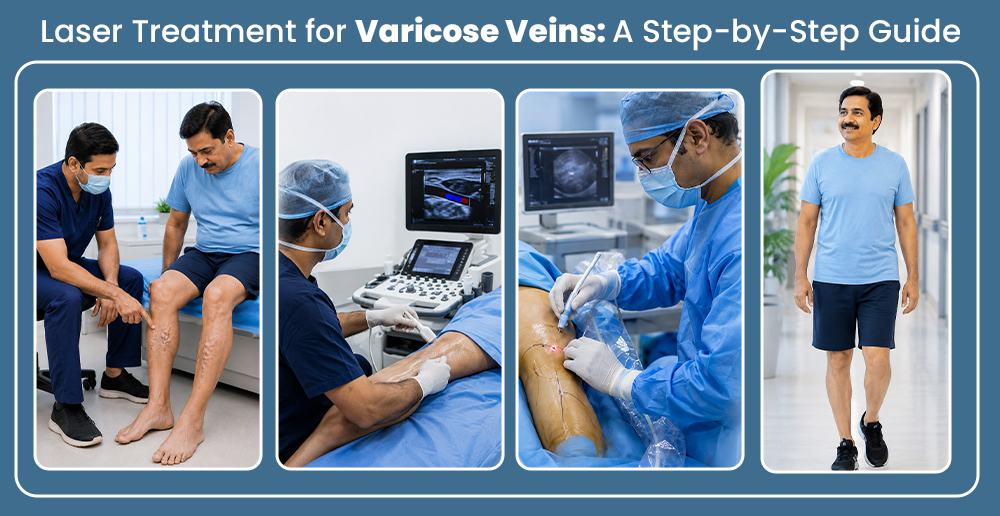
Treatment for varicose veins has advanced significantly since the days of excruciating open surgery. Is now the gold standard. It's a short, almost painless operation that allows patients to leave the same day. This comprehensive guide takes you step-by-step through every step of the laser varicose vein treatment process if you've been thinking about it but are unclear about what actually happens.
sometimes referred to as minimally invasive surgery that seals off damaged veins from the insid using focused laser radiation. Under ultrasound guidance, a thin laser fiber is introduced into the vein, where controlled heat induces it to collapse and permanently seal. In healthy veins, blood naturally reroutes. Large incisions, general anesthesia, and an overnight stay are not necessary for EVLT, in contrast to standard vein stripping.
A duplex ultrasound scan is performed by your specialist after a clinical evaluation. This maps the damaged veins, locates malfunctioning valves, and determines the exact course of treatment.
You change into a gown, and lie down on the treatment table. A sterile field is used to clean, drap, and prepare the leg.
A tiny needle is inserted into the affected vein- typically close to the knee or calf- by the physician using live ultrasonography. To make the laser fiber's course smooth, a guidewire is inserted.
The laser fiber is inserted into place along the defective vein after a thin sheath is advanced over the guidewire. Ultrasound verifies its location.
The vein is surrounded by an injection of a diluted local anesthetic. This compresses the vein against the laser fiber, numbs the area, and shields the surrounding tissue.
The vein wall is sealed when the laser is turned on and gradually moved down the vein. The majority of patients merely experience a slight warmth.
Immediately, a compression stocking is put on. You are usually discharged within an hour and are encouraged to walk immediately.
The table below highlights why EVLT has replaced traditional surgery as the preferred laser varicose veins treatment worldwide.
| Aspect | EVLT (Laser Treatment) | Traditional Vein Stripping |
|---|---|---|
| Anaesthesia | Local (tumescent) | General or spinal |
| Incisions | Single needle puncture | Multiple cuts including the groin |
| Procedure Time | 45 to 60 minutes | 1 to 2 hours |
| Hospital Stay | Outpatient, same-day discharge | Often overnight admission |
| Pain Level | Minimal | Moderate to significant |
| Recovery Time | 1 to 2 days | 2 to 3 weeks |
| Scarring | None visible | Permanent scars at incision sites |
| Success Rate (5 yr) | 94 to 98 percent | Around 70 to 80 percent |
| Recurrence Risk | Low | Higher |
• As directed, wear compression stockings for one to two weeks.
• To promote circulation, walk every day; avoid standing for extended periods of time.
• Within 24 to 48 hours, resume desk work and light activity the same day.
• Steer clear of saunas, hot baths, and strenuous exercise for around two weeks.
• To ensure full vein closure, go to a follow-up ultrasound.
 +91 72079 48545
The management of varicose veins has been completely transformed by EVLT treatment, which offers a safe, walk-in, walk-out technique that produces outstanding long-term outcomes in place of unpleasant surgery. At Avis Hospitals, a detailed ultrasound facilitates accurate diagnosis and based on your specific needs, a personalised treatment plan is developed. Our doctors at Avis, insist on proper follow up visits and compliance with post-treatment instructions, which help to prevent progressive vein conditions. To determine if EVLT is the best option for you, consult our licensed vascular specialist.
EVLT is not considered painful. Most patients only experience minor pressure or a slight warmth throughout the operation because the entire treatment area is numbed by the tumescent anesthesia. The initial needle prick is similar to a standard blood draw. For a few days following treatment, some tightness or bruising around the vein is typical and normally goes away with paracetamol. EVLT is very well tolerated as compared to traditional vein stripping surgery, which frequently needed weeks of rehabilitation and general anesthesia.
Each vein only requires 5 to 10 minutes for the laser section. The entire visit usually takes 45 to 60 minutes and includes ultrasound mapping, sterile preparation, anesthesia, and compression after the treatment. The appointment could last up to 90 minutes if both legs or several veins are being treated. After the operation, you can normally leave the facility within an hour.
Most patients who work light or at a desk return the next day, and many even in the same afternoon. Three to five days of reduced duties may be necessary for jobs requiring a lot of walking, heavy lifting, or prolonged standing. If you feel comfortable doing so, you can drive within a day. Since light walking improves circulation and reduces the danger of blood clots, it is strongly advised from day one. For around two weeks, stay away from the gym, running, hot tubs, and saunas.
Long-term studies have shown closure success rates of 94 to 98 percent at five years, making EVLT one of the most successful vein procedures now accessible. Compared to conventional vein stripping, recurrence rates are far lower. When EVLT is used in conjunction with appropriate follow-up scans and supportive therapies like sclerotherapy for tiny remaining veins, the results are optimal. Within a few weeks, the majority of patients find long-lasting symptom relief and a discernible change in the appearance of their legs.
Although EVLT has a very good safety record, there may be a few small adverse effects. These include small areas of numbness close to the ankle that normally go away in a few weeks, bruising, minor discomfort, and transient tightness along the treated vein. When the treatment is carried out by a skilled vascular specialist, serious complications including skin burns, infection, or deep vein thrombosis are extremely uncommon. If you have extreme pain, sudden swelling, redness that spreads up your leg, or shortness of breath, get in touch with your doctor immediately.