

 25-July-2026
category: varicose veins
25-July-2026
category: varicose veins
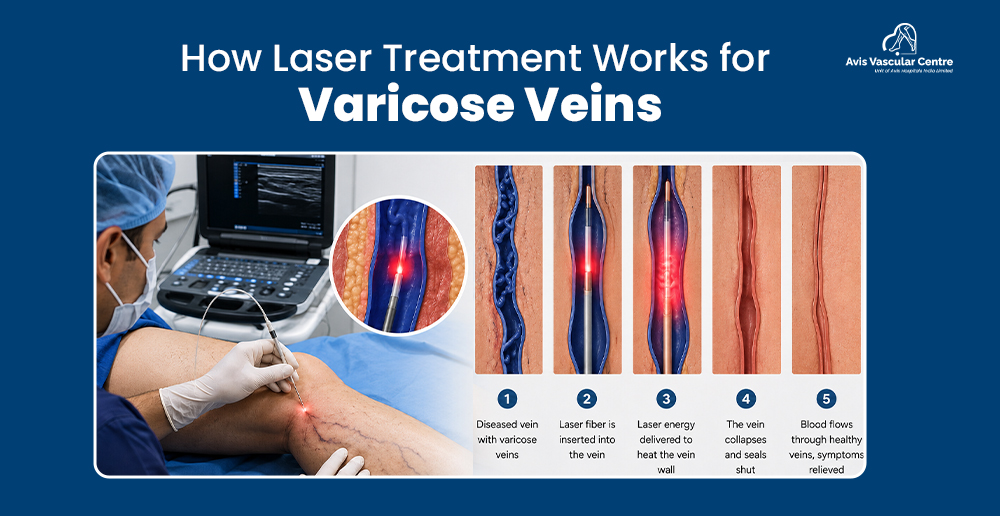
If you've been informed that you require treatment for varicose veins, it's likely that has been discussed. With no scalpels, no general anaesthesia, and no overnight hospital stay, it's one of the most popular minimally invasive vein treatments available today. However, how does a laser really cut off a vein? This is a step-by-step explanation of the vein therapy process.
Whether you’re weighing your options or already scheduled for a consultation, understanding what happens during and after the procedure can make the entire experience far less intimidating.
• Ultrasound mapping: The specialist uses duplex ultrasound to map the faulty vein and plan the exact laser path.
Local anaesthesia: A tumescent (dilute local) anaesthetic is injected along the vein, numbing the area completely while keeping you awake and comfortable.
Fibre insertion: A thin catheter carrying the laser fibre is inserted through a tiny needle puncture, usually near the knee.
• Laser activation: The laser is slowly withdrawn along the vein, delivering controlled heat energy that seals the vein wall shut.
• Compression: A compression bandage or stocking is applied immediately to support the leg and reduce bruising.
• Walk-out recovery: Most patients walk out within the hour and resume light daily activity the same day.
| Feature | Traditional Vein Stripping | EVLT (Laser Treatment) |
|---|---|---|
| Anaesthesia | General or spinal | Local, tumescent anaesthesia only |
| Incisions | Multiple surgical cuts | Single needle-sized entry point |
| Recovery time | 1–2 weeks | Same-day, back to routine within 24–48 hours |
| Scarring | Visible surgical scars | Minimal to none |
| Setting | Hospital, inpatient | Outpatient, walk-in walk-out |
• Neither general anesthesia nor hospitalization are necessary.
• The process usually takes 30 to 45 minutes to finish.
• Minimal scarring, since only a single needle-sized entry point is used
• A high success rate, with the majority of veins permanently shutting
• Going back to work and regular activities quickly, usually within a day or two
For one to two weeks, mild bruising, tightness, or a pulling feeling along the treated vein is typical. In order to promote healing and reduce swelling, compression stockings are typically worn for a week or so. Walking is recommended from day one, and your specialist will advise you to avoid hard lifting and prolonged standing for a brief amount of time.
Doctor Insight: “Most patients are surprised at how little downtime EVLT actually needs. The laser fibre does the work from inside the vein, so there’s no cutting, no stitches, and patients are usually walking normally within the hour.” — Vascular Specialist, Avis Vascular Centre
Patients with visible or symptomatic varicose veins, such as heaviness, pain, swelling, or skin abnormalities, and verified valve reflux on a Doppler ultrasonography are usually advised to have EVLT. Before determining suitability, a vascular specialist will evaluate the vein's size, location, and general health because extremely tortuous or superficial veins might require a complementary procedure like sclerotherapy.
 +91 72079 48545
Compared to traditional surgery has made vein treatment treatments quicker, less intrusive, and much easier to recover from. A Doppler evaluation at Avis Hospitals can determine whether EVLT is the best minimally invasive vein treatment for you if you have symptomatic varicose veins; most patients recover the same day.
No. The area is fully numbed with local anaesthesia, so patients feel pressure or warmth at most, not pain.
Most people return to normal daily activity within 24–48 hours and resume exercise within a week or two, depending on the specialist’s advice.
The treated vein closes permanently and is reabsorbed by the body. However, new varicose veins can develop elsewhere over time, so periodic follow-up is recommended.
No visible surgical scars form, since the procedure uses a single small needle entry point rather than incisions.